Person in the Old Testament
Asaph
Asaph: the Levite singer David set before the ark
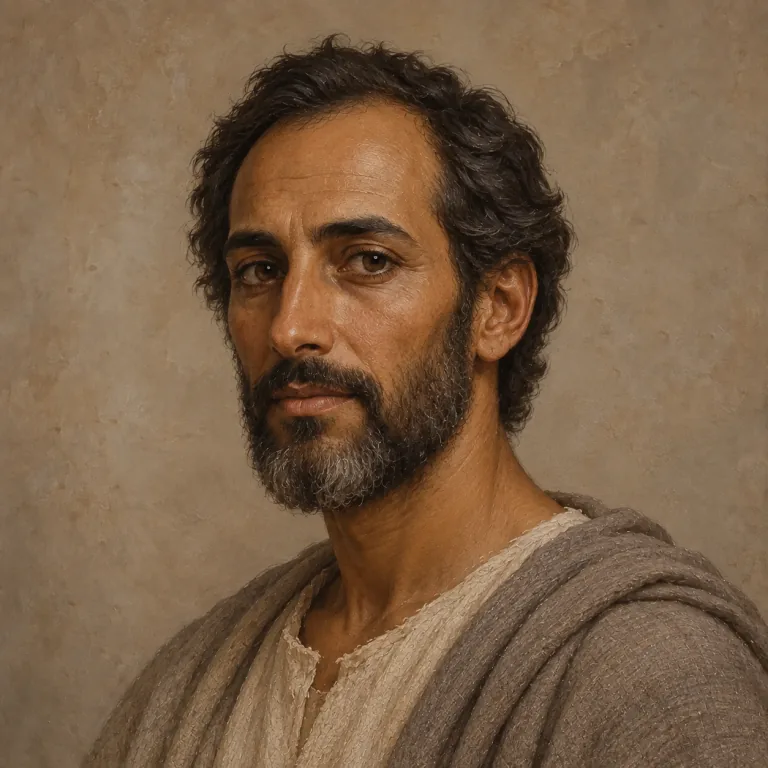
Portrait: an AI-generated artistic interpretation, not evidence of how Asaph looked.
Who Asaph is
Asaph is a Levite of the line of Gershom, "the son of Berachiah", whom chapter 6 places on the right hand of Heman among the singers David set over the service of song. When the ark is brought to Jerusalem the Levites appoint him with Heman and Ethan, and the three sound "cymbals of brass". In the tent David makes him "the chief" of the Levites who minister before the ark, and "on that day" David delivers a psalm of thanks "into the hand of Asaph and his brethren"; David then leaves Asaph there "to minister before the ark continually". Later David and the captains set apart the sons of Asaph, Heman and Jeduthun to prophesy with instruments; Asaph's four sons serve "under the hands of Asaph, which prophesied according to the order of the king", and the first lot falls to his son Joseph. At Solomon's dedication the singers "of Asaph, of Heman, of Jeduthun" stand in white linen at the altar. Under Jehoshaphat a Levite "of the sons of Asaph" receives the Spirit; under Hezekiah two sons of Asaph help cleanse the house, and the Levites are told to praise "with the words of David, and of Asaph the seer"; under Josiah the singers the sons of Asaph keep their place. Two registers of the return from exile count the singers as "children of Asaph", 128 in Ezra and 148 in Nehemiah; his sons sound cymbals at the temple's foundation, a descendant leads the thanksgiving, and Nehemiah remembers "the days of David and Asaph of old" as the time of the chief singers.
Cited passages: 1 Chronicles 6:39, 1 Chronicles 6:43, 1 Chronicles 6:31, 1 Chronicles 15:17, 1 Chronicles 15:19, 1 Chronicles 16:5, 1 Chronicles 16:7, 1 Chronicles 16:37, 1 Chronicles 25:1, 1 Chronicles 25:2, 1 Chronicles 25:9, 2 Chronicles 5:12, 2 Chronicles 20:14, 2 Chronicles 29:13, 2 Chronicles 29:30, 2 Chronicles 35:15, Ezra 2:41, Nehemiah 7:44, Ezra 3:10, Nehemiah 11:17, Nehemiah 11:22, Nehemiah 12:46
Historical setting
The text gives Asaph a father, Berachiah (spelled Berechiah in chapter 15), a Gershomite ancestry, four named sons, and a standing office before the ark; it records no words of his own, and his only recorded actions are standing in the choir, sounding cymbals, receiving the psalm and prophesying with his sons "according to the order of the king". His title "the seer" appears only once, in Hezekiah's command, long after his time. Most references after 1 Chronicles are to "the sons of Asaph" or "the children of Asaph", a guild of singers named for him rather than the man himself, and Nehemiah looks back on "the days of David and Asaph of old". Two other men share the name and should not be confused with him: Joah "the son of Asaph the recorder" under Hezekiah, and Asaph "the keeper of the king’s forest" in Nehemiah's day. Chapter 26 also lists a Korhite gatekeeper "of the sons of Asaph", a different Levite line from the Gershomite singer, and chapter 9 traces a Korhite gatekeeper through "the son of Kore, the son of Ebiasaph". The character index links Psalms 50 and 73 to 83 to Asaph through their superscriptions, but the verse text printed in this source begins with the first line of each psalm and omits the heading, so nothing quoted here shows the attribution; a superscription in any case attaches a name to a psalm without proving who wrote it. The psalm in 1 Chronicles 16 is one David "delivered" to Asaph; neither text says that Asaph composed anything.
Cited passages: 1 Chronicles 6:39, 1 Chronicles 15:17, 1 Chronicles 25:2, 2 Chronicles 29:30, Ezra 2:41, Nehemiah 12:46, 2 Kings 18:18, Nehemiah 2:8, 1 Chronicles 26:1, 1 Chronicles 9:19, Psalms 50:1, Psalms 73:1, Psalms 83:1, 1 Chronicles 16:7
How the story is told
Asaph is presented by position rather than by story. In chapter 6 he is a name in a line and a place in a choir, "on his right hand"; in chapters 15 and 16 he is the one who sounds the cymbals and receives the psalm; in chapter 25 he is a father whose sons prophesy under his hands. The Chronicler uses him as the fixed point of temple song: when the ark is settled, Asaph stays; when Solomon dedicates the house, the singers are still "of Asaph"; when later kings reform, they appeal to "the words of David, and of Asaph" or to "the commandment of David, and Asaph". Ezra and Nehemiah continue this by counting the returning singers as his children and by pairing his name with David's as the origin of praise. His role in each book's argument is continuity: song in the second temple is authorized by pointing back to him. The one time the Spirit is said to come on a man of his house, the man is a descendant, Jahaziel, and the scene belongs to Jehoshaphat's story, not Asaph's.
Cited passages: 1 Chronicles 6:39, 1 Chronicles 16:5, 1 Chronicles 25:6, 1 Chronicles 16:37, 2 Chronicles 5:12, 2 Chronicles 29:30, 2 Chronicles 35:15, Ezra 3:10, Nehemiah 12:46, 2 Chronicles 20:14
Story moments
- At Heman's right hand (1 Chronicles 6:39). Asaph the son of Berachiah stands beside Heman among David's singers.
- Appointed with cymbals of brass (1 Chronicles 15:19). The Levites appoint Heman, Asaph and Ethan to sound the cymbals as the ark comes up.
- Chief before the ark (1 Chronicles 16:5). David makes Asaph chief of the Levites ministering before the ark.
- The psalm placed in his hand (1 Chronicles 16:7). David delivers a psalm of thanks to Asaph and his brethren.
- His sons prophesy under him (1 Chronicles 25:2). Asaph's four sons serve under his hands according to the king's order.
- Hezekiah recalls his words (2 Chronicles 29:30). The Levites are told to praise with the words of David and of Asaph the seer.
- His children return from exile (Ezra 3:10). The sons of Asaph sound cymbals when the temple's foundation is laid.
Key passages
1 Chronicles 6:39
And his brother Asaph, who stood on his right hand, even Asaph the son of Berachiah, the son of Shimea,
1 Chronicles 15:17
So the Levites appointed Heman the son of Joel; and of his brethren, Asaph the son of Berechiah; and of the sons of Merari their brethren, Ethan the son of Kushaiah;
1 Chronicles 15:19
So the singers, Heman, Asaph, and Ethan, were appointed to sound with cymbals of brass;
1 Chronicles 16:5
Asaph the chief, and next to him Zechariah, Jeiel, and Shemiramoth, and Jehiel, and Mattithiah, and Eliab, and Benaiah, and Obed-edom: and Jeiel with psalteries and with harps; but Asaph made a sound with cymbals;
1 Chronicles 16:7
Then on that day David delivered first this psalm to thank the Lord into the hand of Asaph and his brethren.
1 Chronicles 16:37
So he left there before the ark of the covenant of the Lord Asaph and his brethren, to minister before the ark continually, as every day’s work required:
King James Version. 33 indexed passages in total.
For reflection
Asaph never speaks in the text, yet long afterward kings and returning exiles justify their singing by his name. What does it take for a person's work to outlast any record of the person?
Books Asaph appears in
Related people






Names and references are adapted from STEPBible TIPNR. A person listed with a verse is named or indexed there; it does not mean they wrote or spoke it.