Person in the Old Testament
Haman
Haman: the Agagite who plotted the Jews' destruction and died on his own gallows
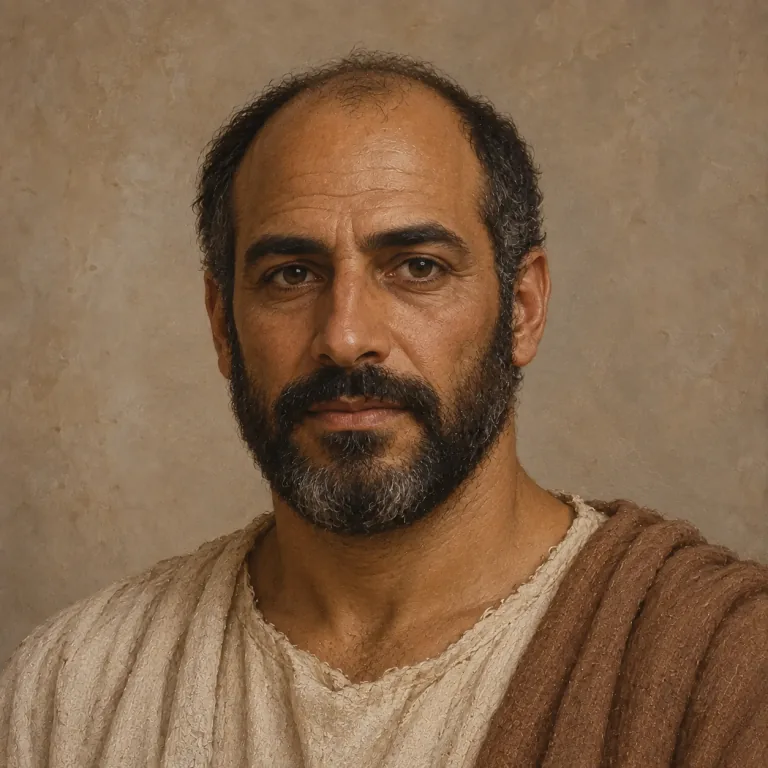
Portrait: an AI-generated artistic interpretation, not evidence of how Haman looked.
Who Haman is
Haman the son of Hammedatha the Agagite is promoted by king Ahasuerus above all the princes, and the king's servants bow to him by royal command. When Mordecai does not bow, Haman is full of wrath and, scorning to strike one man, seeks to destroy all the Jews in the kingdom. The lot is cast before him, and he persuades the king that a certain people whose laws differ should be destroyed, offering ten thousand talents of silver; the king gives him his ring, and letters go out to kill all Jews on the thirteenth of Adar. Esther invites Haman with the king to two banquets. Between them he sees Mordecai unmoved at the gate, tells his wife Zeresh and his friends that all his honours avail him nothing, and on their advice builds a gallows fifty cubits high for Mordecai. That night the king, unable to sleep, learns that Mordecai was never rewarded for exposing a plot, and asks Haman what should be done for the man the king delights to honour. Haman, assuming the king means him, describes royal apparel, a horse and a procession, and is ordered to do all of it for Mordecai. He goes home mourning, and his wise men and Zeresh tell him he will fall. At the second banquet Esther says she and her people have been sold, and names him as the adversary and enemy. The king goes out in wrath; Haman begs Esther for his life and is found fallen on her bed when the king returns. His face is covered, and at Harbonah's word he is hanged on the gallows he made for Mordecai. His house is given to Esther, his ring to Mordecai, and his ten sons are killed and hanged when the Jews defend themselves.
Cited passages: Esther 3:1, Esther 3:2, Esther 3:5, Esther 3:6, Esther 3:7, Esther 3:8, Esther 3:9, Esther 3:10, Esther 3:13, Esther 5:4, Esther 5:9, Esther 5:13, Esther 5:14, Esther 6:1, Esther 6:3, Esther 6:6, Esther 6:10, Esther 6:12, Esther 6:13, Esther 7:6, Esther 7:7, Esther 7:8, Esther 7:9, Esther 7:10, Esther 8:1, Esther 8:2, Esther 9:10, Esther 9:14
Historical setting
Haman appears only in Esther, in forty-five verses from chapter 3 to chapter 9. The text names his father, Hammedatha, and calls him the Agagite, a term the book uses several times without explaining. The narrator labels him the Jews' enemy and the enemy of all the Jews; Esther calls him the adversary and enemy and this wicked Haman. His household is named as Zeresh his wife, his friends, and ten sons, who are listed by name when they are killed; he himself speaks of the multitude of his children. His motive is stated by the narrator as wrath at Mordecai's refusal to bow, and his plan as extending from Mordecai to the people of Mordecai; the text gives no earlier history between the two men. In his speech to the king he never names the people he describes. Two accounts of his last moments stand together: the narrator says he stood up to make request for his life, and the king asks whether he would force the queen. The text does not say what the covering of his face means. The narrator says he built the gallows, the ring passed to him and back, and his house was given to Esther; the ten thousand talents are called a promise to pay, and the text does not say whether the silver changed hands.
Cited passages: Esther 3:1, Esther 3:10, Esther 9:24, Esther 7:6, Esther 5:10, Esther 9:7, Esther 9:10, Esther 5:11, Esther 3:5, Esther 3:6, Esther 3:8, Esther 7:7, Esther 7:8, Esther 8:2, Esther 8:1, Esther 4:7
How the story is told
Haman is the figure through whom the book's reversals run. He is set above all the princes and ends hanged; he builds a gallows for Mordecai and dies on it; he designs an honour for himself and performs it for the man he hates; the ring the king gives him passes to Mordecai. The narrator lets him speak at length in his own house, where his catalogue of riches, children and promotions ends in the admission that all of it avails him nothing, and then gives him no words at all at the banquet where he is named. His inward thought, that the king can mean no one but himself, is reported so that the reader hears his assumption before the king corrects it. Zeresh and the friends who advise the gallows are the same voices that predict his fall the next day. The chapters mirror his rise and ruin: the scribes, posts and sealed letters of chapter 3 are answered in chapter 8 with the same formulas turned the other way, and the city that was perplexed when he sat down to drink with the king rejoices when Mordecai goes out in royal apparel.
Cited passages: Esther 3:1, Esther 7:10, Esther 6:11, Esther 3:10, Esther 8:2, Esther 5:11, Esther 5:13, Esther 7:6, Esther 6:6, Esther 5:14, Esther 6:13, Esther 3:12, Esther 8:10, Esther 3:15, Esther 8:15
Story moments
- Set above the princes (Esther 3:1). The king promotes Haman above all the princes.
- Wrath at Mordecai (Esther 3:5). Haman is full of wrath when Mordecai does not bow.
- The decree obtained (Esther 3:10). The king gives Haman his ring against the people he has described.
- All this availeth me nothing (Esther 5:13). Haman says his honours mean nothing while Mordecai sits at the gate.
- Honouring the man he hates (Esther 6:11). Haman leads Mordecai through the city in royal apparel.
- Named by Esther (Esther 7:6). Esther names Haman as the adversary and enemy.
- Hanged on his own gallows (Esther 7:10). Haman is hanged on the gallows he prepared for Mordecai.
Key passages
Esther 3:1
After these things did king Ahasuerus promote Haman the son of Hammedatha the Agagite, and advanced him, and set his seat above all the princes that were with him.
Esther 3:2
And all the king’s servants, that were in the king’s gate, bowed, and reverenced Haman: for the king had so commanded concerning him. But Mordecai bowed not, nor did him reverence.
Esther 3:4
Now it came to pass, when they spake daily unto him, and he hearkened not unto them, that they told Haman, to see whether Mordecai’s matters would stand: for he had told them that he was a Jew.
Esther 3:5
And when Haman saw that Mordecai bowed not, nor did him reverence, then was Haman full of wrath.
Esther 3:6
And he thought scorn to lay hands on Mordecai alone; for they had shewed him the people of Mordecai: wherefore Haman sought to destroy all the Jews that were throughout the whole kingdom of Ahasuerus, even the people of Mordecai.
Esther 3:7
In the first month, that is, the month Nisan, in the twelfth year of king Ahasuerus, they cast Pur, that is, the lot, before Haman from day to day, and from month to month, to the twelfth month, that is, the month Adar.
King James Version. 45 indexed passages in total.
For reflection
Haman tells his household that riches, children and promotions avail him nothing while one man will not rise for him. What does the text show about a grievance that grows from a single refusal into a decree against a whole people?
Books Haman appears in
Related people

Names and references are adapted from STEPBible TIPNR. A person listed with a verse is named or indexed there; it does not mean they wrote or spoke it.